A white paper · September 2026
The Plumbing Was Never the Point
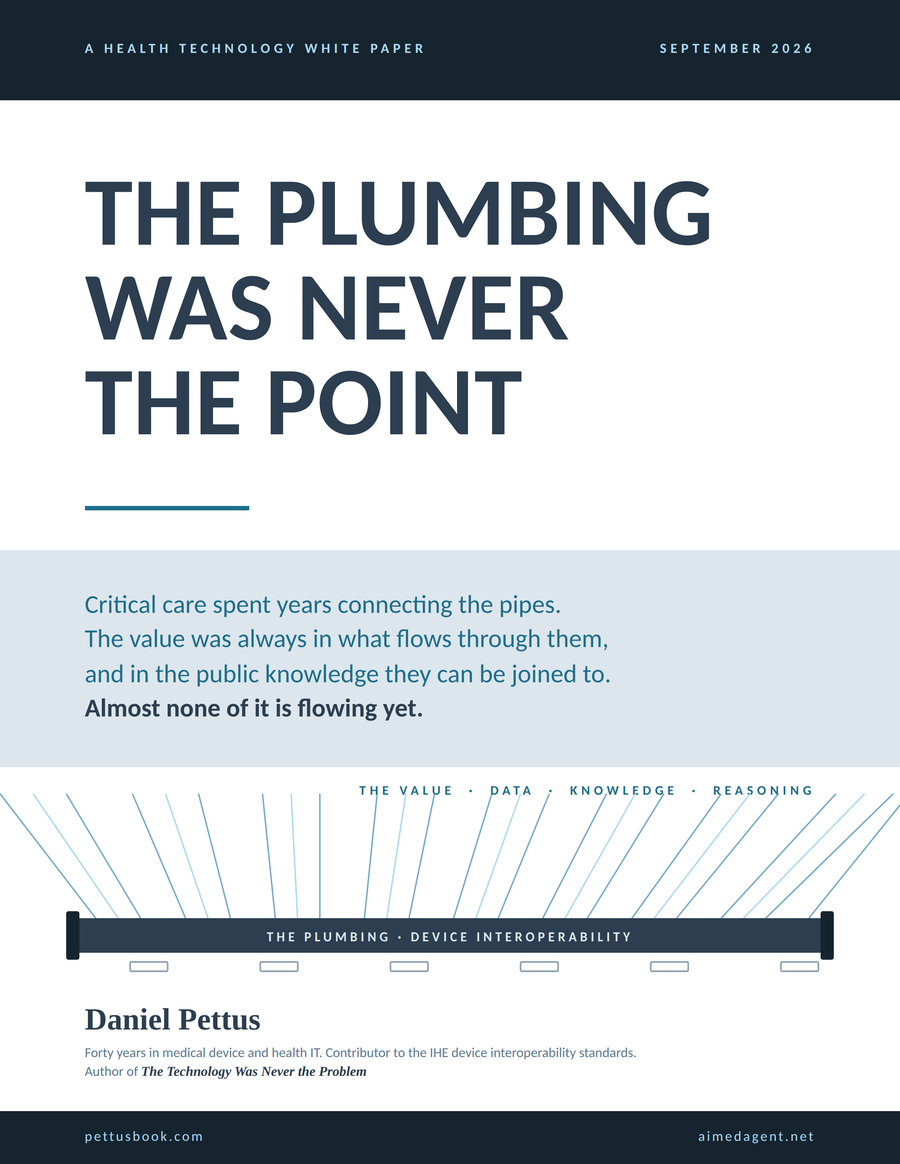
Interoperability was the pipe. The value is the data that flows through it, joined to the public knowledge the country already built, and reasoned over at the bedside.
A white paper · September 2026
Interoperability was the pipe. The value is the data that flows through it, joined to the public knowledge the country already built, and reasoned over at the bedside.
Free · 17 pages · every number sourced
Read it, share the link, cite it. No sign-up, no paywall.
Download the PDF View the record on Zenodo
Cite as: Pettus DC. The Plumbing Was Never the Point: interoperability, data, and the unclaimed value in critical-care therapy management. White paper, September 2026. DOI: 10.5281/zenodo.22710022
In 2013 the West Health Institute measured what medical device interoperability was worth and put the number above thirty billion dollars a year. That number was real then and it is real now. But it measured the pipe.
The larger prize was never the connection itself. It is the data that moves through the connection once it exists, joined to the public knowledge the country already paid to build, carried in a common language all the way back to the Unified Medical Language System, and reasoned over while the patient is still in the bed. In critical care, where the sickest patients throw off the most data and the least of it is used to look forward, that prize is almost entirely unclaimed.
West measured the pipes. This measures what is worth pumping through them, with two ordinary bedside cases that show what changes when the value, and not the plumbing, becomes the point.
Interoperability means whatever the person using the word needs it to mean. To an EHR team it means chart data moving across vendors. To radiology it means a DICOM image opens in any viewer. To an infusion pump company it means a validated order, aligned from the formulary to CPOE to the eMAR, programming the pump and the pump reporting back. Every one of those is real plumbing, every one has a gap, and the paper uses the infusion pump as its working example because it is the one place the loop actually closes.
Once the pipe exists, two streams can move through it: the patient's own live data, and the public knowledge the country already built and gives away, the FDA's drug labels, the adverse event reports, the clinical terminologies. Neither is worth much alone. The common language that joins them, RxNorm, LOINC and SNOMED CT unified by the UMLS, has been sitting in the public domain the entire time.
The value is in reasoning over the joined data, forward, before a slow harm becomes an obvious one, and handing what it finds, with its evidence, to a human who can act. Not a machine choosing a dose. Oversight that shows its work. That step arrived from outside medicine and is available now. Connecting it to a human is still unsolved, and it is where the outcomes live.
How the numbers were checked. Every figure carries a numbered citation and was confirmed at its primary source before it went in. Where a claim is my judgment rather than a sourced fact, the text says so. An appendix lists every number and where it came from. If you find one that does not hold, tell me and I will publish the correction rather than quietly fix it.
This is the companion argument to The Technology Was Never the Problem. The book says the technology was never the barrier. The paper says the plumbing was never the point. Same spine, next chapter.
Inside the Loop is where this argument keeps going, free. The reasoning layer the paper describes runs in the open, on simulated patients, at aimedagent.net.